Clinical Explainer
Biomarker 101: Understanding Your TRT Labs
One TRT lab panel covers more than testosterone. What total and free T, SHBG, LH, FSH, and the rest of the panel are actually monitoring.

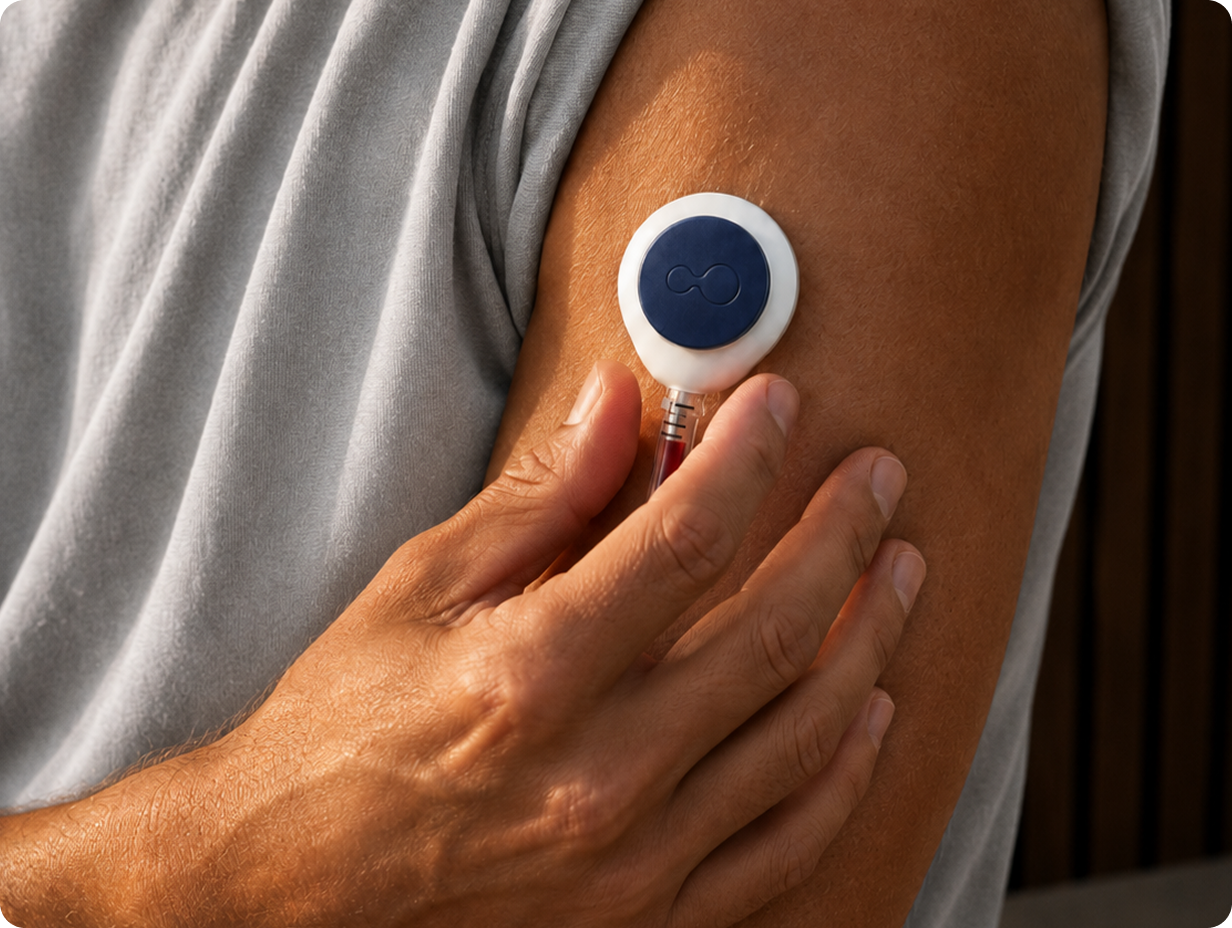
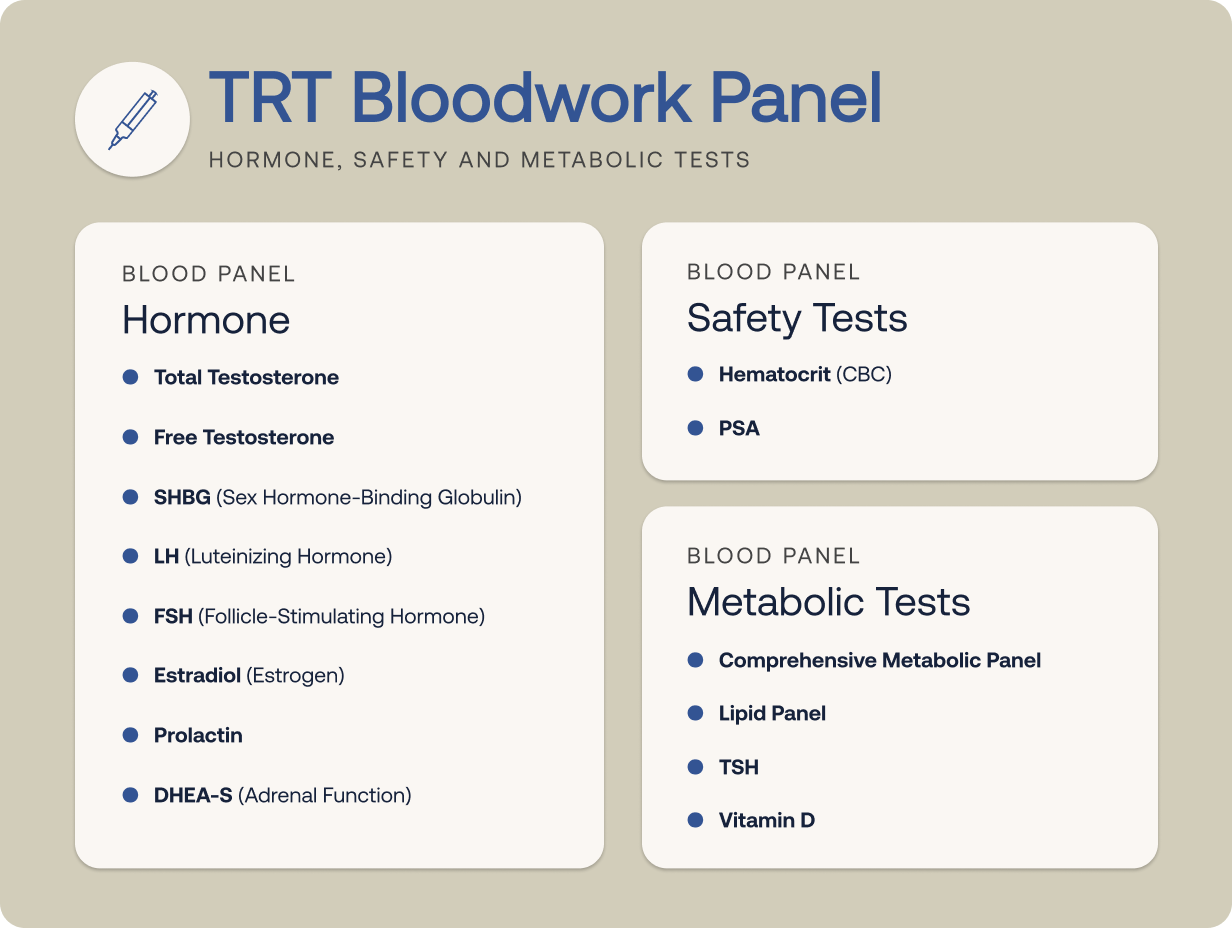
When you come to us for testosterone therapy (TRT), we draw one comprehensive lab panel — your TRT blood work — because testosterone does not work alone. Treating it properly means looking at the systems around it too: other hormones, your metabolism, the prostate, your blood count, pituitary gland and thyroid. Here is what we are monitoring and why.
Checking testosterone levels**: Total, Free, SHBG, LH & FSH**
- Total testosterone
- Free testosterone
- SHBG (Sex Hormone-Binding Globulin)
- LH (Luteinizing Hormone) and FSH (Follicle-Stimulating Hormone)
Most of the testosterone circulating in the blood is attached to a protein and cannot do much in that state. Only the unbound portion, called free testosterone, is available for tissues to use. That protein is SHBG, sex hormone-binding globulin, made mostly by the liver, and it is the reason total testosterone is never looked at by itself. Two men can post the same total testosterone number and have noticeably different amounts of it available to their bodies, because one of them has far more SHBG soaking up the supply. The total describes how much testosterone exists. The ratio between total and SHBG describes how much of it the body can use.
Testosterone production does not begin in the testes, but rather, in the brain, where the hypothalamus and pituitary gland send out LH and FSH, hormones that signal and instruct the testes to produce testosterone. We check both these values because high LH and FSH alongside low testosterone tells us that the signal from the brain is strong, but the testes are not responding. A low or unremarkable LH and FSH alongside low testosterone tells us the signal itself is weak, and that we need to look further into the pituitary or hypothalamus.
Related Hormones: Estradiol, Prolactin & DHEA-S
- Estradiol
- Prolactin
- DHEA-S
Some testosterone in the body is converted by an enzyme called aromatase into estradiol, the most potent form of estrogen, which involved in bone density, joint tissue, and libido, in men just as in women. Because estradiol is made directly from testosterone, its levels will change in relation to testosterone levels, which is why we read the two together rather than separately.
Prolactin is not part of the testosterone production pathway, but because it is also made by the pituitary gland, it gives us a window into how that gland is working overall, sitting alongside LH and FSH as another data point on pituitary function.
DHEA-S comes from a different gland entirely, the adrenal glands sitting above the kidneys, where it serves as a raw material the body can convert into other hormones, testosterone among them. It declines naturally with age, which is why we check it alongside total testosterone, free testosterone, LH, and FSH, adding another data point to the overall hormonal picture.
Safety Monitoring: Hematocrit & PSA
- Hematocrit (part of a complete blood count)
- PSA (Prostate-Specific Antigen)
Testosterone has the ability to stimulate the bone marrow to produce more red blood cells, and hematocrit, measured as part of a complete blood count, tells us what percentage of the blood is made up of those cells. We track it closely because a higher concentration of red cells makes the blood thicker, and thicker blood is harder for the heart to move through the vessels.
PSA, prostate-specific antigen, is a protein made by the prostate gland, and the amount in the blood can shift from one reading to the next for reasons that have nothing to do with prostate health. A single number taken alone can be misleading in either direction, which is why we build a baseline and follow the trend over successive draws, watching for a pattern that holds rather than reacting to one result.
Whole-Body Markers: Metabolic Panel, Lipids, TSH & Vitamin D
- Comprehensive metabolic panel (kidney, liver, blood sugar, electrolytes)
- Lipid panel
- TSH
- Vitamin D
A comprehensive metabolic panel checks kidney function, liver function, blood sugar, and electrolytes such as sodium and potassium. The liver is where much of testosterone processing takes place, so its condition affects how the hormone moves through the body. The kidneys clear waste and help regulate fluid balance, both relevant before adding any new hormone to the system. Blood sugar and electrolytes round out a picture of how the metabolism and the nervous and muscular systems are functioning, independent of the hormonal panel above.
A lipid panel measures cholesterol and triglycerides, the fats that, at elevated levels, build up inside blood vessel walls over time and narrow them, so this panel speaks to cardiovascular risk from a different direction than hematocrit does.
TSH, thyroid-stimulating hormone, comes from the pituitary gland as well, signaling the thyroid the same way LH and FSH signal the testes. The thyroid produces hormones that regulate metabolism throughout the body, which is why thyroid function is checked as part of a complete hormonal picture rather than assumed to be unrelated. Vitamin D supports calcium absorption for bone strength, along with immune and muscle function, and it is common enough to run low that it is checked as a matter of course.

Why it all comes from one draw
This panel is an assessment, not just of testosterone levels, but of everything that testosterone affects and everything that allows it to be produced in the first place.
This is meant to explain what we are measuring and why. Please talk to your provider if you have any questions about your individual results.
Start with the full picture
This measurement-first approach is how care works at ForHumanity — one comprehensive panel, reviewed by a licensed clinician, so any testosterone decision is based on your full hormonal and metabolic picture. Explore testosterone therapy
Frequently Asked Questions
Q: What blood tests are needed for TRT?
A: A comprehensive panel from one draw: total and free testosterone, SHBG, LH and FSH; estradiol, prolactin, and DHEA-S; hematocrit (via CBC) and PSA for safety; plus a metabolic panel, lipid panel, TSH, and vitamin D.
Q: Why is estradiol checked during testosterone therapy?
A: Some testosterone converts (via aromatase) into estradiol, which matters for bone density, joints, and libido in men. Because it's made from testosterone, it moves with testosterone — so the two are read together.
Q: Why is hematocrit monitored on TRT?
A: Testosterone can raise red blood cell production. If hematocrit climbs too high the blood thickens and is harder for the heart to move, so it's tracked closely.
Q: What is SHBG and why does it matter for testosterone?
A: SHBG is a liver protein that binds most circulating testosterone, leaving only the free portion usable. Two men with the same total can have different amounts available if their SHBG differs — which is why total is never read alone.
This article is for educational purposes and is not medical advice and is meant to explain what we are measuring and why. Please talk to your provider if you have any questions about your individual results.
