Clinical Explainer
Injectable Testosterone: How It Works and What to Expect
How injectable testosterone works in the body, why esters exist, and what to expect across a dosing cycle.


If you have started testosterone replacement therapy (TRT) or are considering it, you may have questions about the injectable form — how it works in the body, what the difference is between the two main options, and why some people feel differently at different points in their dosing cycle. The answers are fairly straightforward.
How Injectable Testosterone Works in the Body
Testosterone in its unmodified form clears the body within minutes when injected, which makes it impractical for therapy. To solve this, the testosterone molecule is attached to a chemical chain called an ester, which slows its release from the injection site into the bloodstream. The longer the ester chain, the more gradually the hormone is released and the longer it remains active. It is for this reason that injections can be spaced days and sometimes weeks apart, rather than requiring daily administration.
Testosterone Cypionate vs. Enanthate — What Is the Difference?
The two most commonly prescribed injectable forms are testosterone cypionate and testosterone enanthate. They are nearly interchangeable in terms of clinical effect — both deliver the same active hormone and both have decades of clinical use supporting their safety and effectiveness. The differences are largely practical:
- Cypionate has a half-life of roughly 7–8 days; enanthate is slightly shorter at around 4–7 days
- Cypionate is dissolved in cottonseed oil, which tends to be easier to inject
- Enanthate uses sesame oil, which is more viscous and can occasionally cause more localized discomfort at the injection site
- In the United States, cypionate is the more commonly prescribed of the two
The choice between them is usually a matter of availability, provider preference, and individual tolerance rather than a significant clinical distinction.
Testosterone Peaks and Troughs: Why You Feel Different Across the Cycle
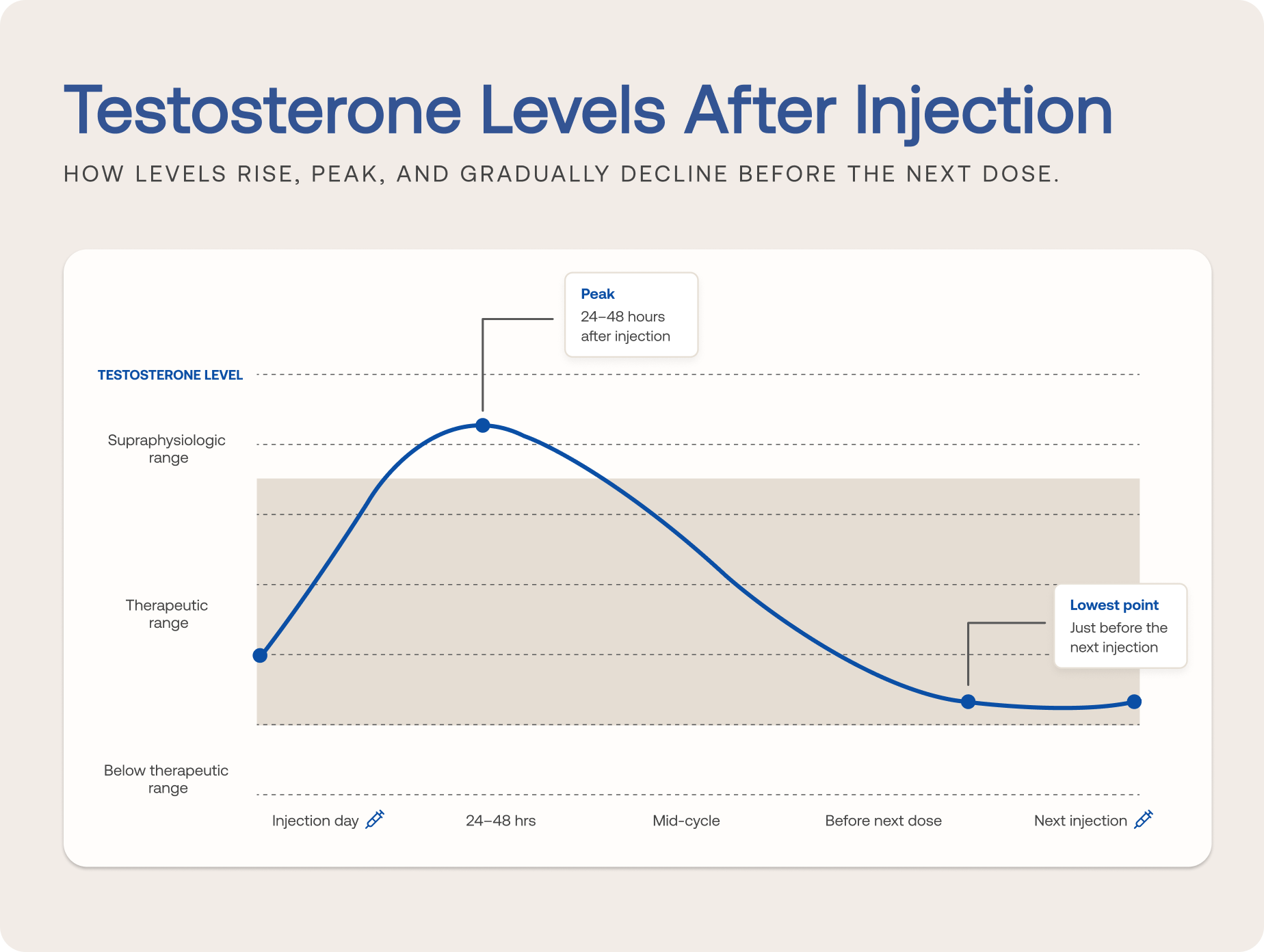
One of the most important things to understand about injectable testosterone — and one that often explains why some people feel inconsistent effects — is the pattern of levels that follows each injection. After an intramuscular injection, testosterone levels tend to rise into a supraphysiologic range within the first 24 to 48 hours, then gradually decline over the following days. If the next injection is delayed too long, levels may fall below the therapeutic range before it arrives.
Some men notice this as a pattern in how they feel — more energy, better mood, and stronger libido in the days following an injection, with a gradual shift as they approach the next one. More frequent dosing at lower amounts tends to produce more stable levels and may reduce these fluctuations. Split dosing, where the weekly total is divided into two smaller injections, can smooth the curve further for those who are sensitive to it.
What to Monitor on Injectable Testosterone
Injectable testosterone does not simply raise testosterone levels in isolation, which is why ongoing monitoring matters. Key markers to follow include:
- Testosterone levels — drawn at the midpoint between injections to reflect your true average, not a peak or trough
- Estradiol — because testosterone converts to estrogen through a process called aromatization, estradiol levels may rise alongside testosterone and can contribute to water retention, mood changes, and other symptoms if they climb too high
- Hematocrit — testosterone stimulates red blood cell production, and hematocrit levels that rise too high can increase cardiovascular risk and should be checked regularly
- PSA — prostate-specific antigen is monitored as a standard safety measure throughout treatment
The goal is to maintain testosterone within a mid-normal physiological range — not to maximize it — while keeping the other markers in a safe zone.
Why Individual Response to TRT Varies
Two people on the same dose and the same protocol may feel quite differently, and that is not unusual. Individual differences in metabolism, body composition, aromatase activity, and baseline hormone levels all influence how the body responds. Some people convert more testosterone to estrogen than others. Some are more sensitive to fluctuations in levels. Finding the right dose and frequency is a process of adjustment over time, guided by both lab values and how you are actually feeling — and both matter.
Working With Your Provider on TRT
Injectable testosterone therapy works best when it is managed as an ongoing conversation with your healthcare provider rather than a set-it-and-forget-it protocol. If you notice changes in how you feel at different points in your dosing cycle — shifts in energy, mood, libido, or sleep — let your provider know. These patterns are useful clinical information and can guide adjustments to your dose or frequency. The same is true for any new or unexpected symptoms. Regular lab monitoring combined with open communication gives your provider the clearest picture of how your body is responding and what, if anything, needs to change.
If you would like to understand more about how testosterone functions in the body and what drives deficiency in the first place, <u>you can read more here</u> (link to other article).
Explore Injectable TRT
If you're considering injectable testosterone, the right protocol is the one built around your labs and how you feel — and adjusted over time. That's how care works at ForHumanity: a clinical assessment, appropriate lab work, and a licensed clinician who manages your plan as an ongoing conversation.
Frequently Asked Questions
How often should you inject testosterone?
The ideal injection schedule depends on the type of testosterone prescribed, your hormone levels, and how your body responds to treatment. Many people inject once or twice weekly, although some benefit from smaller, more frequent doses to maintain steadier hormone levels. Your healthcare provider will determine the schedule that is right for you.
Why do I feel different before my next testosterone injection?
Testosterone levels gradually decline between injections, so some people notice changes in energy, mood, libido, or overall well-being as they approach their next dose. If these fluctuations are significant, your provider may recommend adjusting your dose or injection frequency to achieve more stable levels.
What should be monitored while taking injectable testosterone?
_Regular monitoring helps ensure that treatment remains both effective and safe. Yo_ur healthcare provider will typically monitor testosterone levels, hematocrit, estradiol, PSA, and other laboratory markers based on your age, medical history, and treatment goals.
Can I inject testosterone myself?
Yes. Many people safely administer testosterone injections at home after receiving proper instruction from their healthcare provider. Learning the correct injection technique, rotating injection sites, and following safe handling practices can help minimize discomfort and reduce the risk of complications.
This article is for educational purposes and is not medical advice. Testosterone therapy is available by prescription following clinical evaluation. Always consult a licensed clinician about your individual treatment.
